
Colocation Data CenterPower Protection
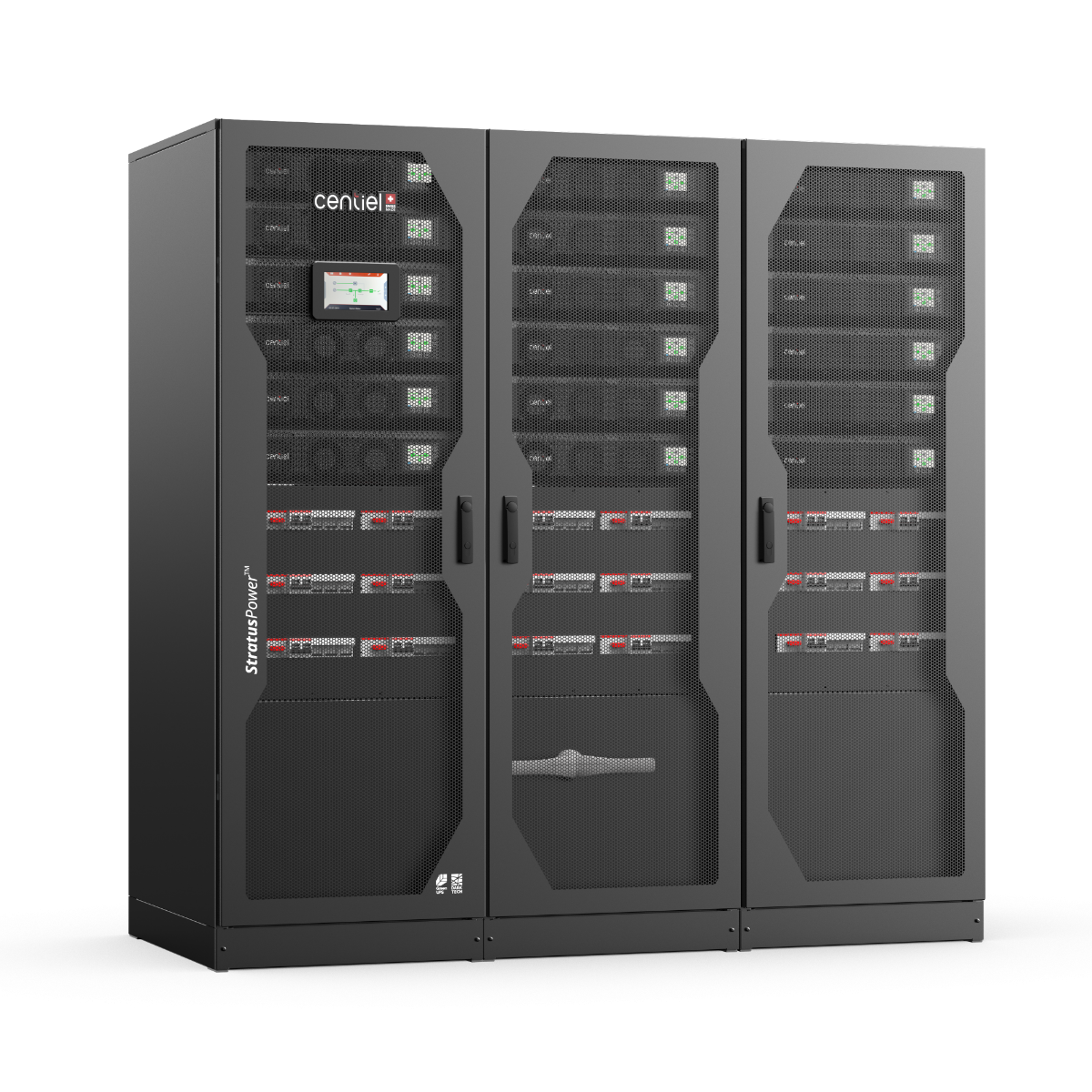

Colocation Data CenterAudit Ready

Colocation Data CenterScalable Without Redesign

Colocation Data CenterDesigned to Enable Zero-Downtime Maintenance

ePods
Containerized UPS deployed in weeks, not months

2-6 hrs
SLA Commitment. Global deployment & service footprint

32 years
Mission-critical
engineering

4–6 weeks
Typical order to
delivery lead time
Uptime isn't specified. It's designed.
Specifications matter. But the decisions that protect uptime, preserve margin, and survive audits aren’t made on datasheets. They’re made on how systems behave under load, over time, when something goes wrong.

Uptime & Redundancy
Architecture that eliminates single points of failure — not just adds backup capacity.

Lead Time & Delivery
Schedules that protect your commissioning window — not hostage you to 18-month forecasts.

Availability, MTTR & MTBF
Measurable reliability: how fast you recover, how long
between failures, how the system performs over its lifecycle.

Lifecycle Cost
TCO that survives finance scrutiny: efficiency, serviceability, and downtime risk over 15 years.

Downtime is personal accountability
In Colocation, a power failure isn’t just a technical incident — it’s a business event.
SLA penalties trigger before root cause is clear.
Customer churn accelerates. Reputation recovery takes months, not days, and accountability doesn’t diffuse.
It lands on the infrastructure leader who approved the architecture, the vendor, the maintenance plan.
The question isn’t whether failure is possible. It’s whether the system is designed to contain it.

Reviewing architecture before DCW London March 4th-5th?

UPS Designed to Eliminate Failures
Traditional UPSs are designed with intrinsic points of failure.
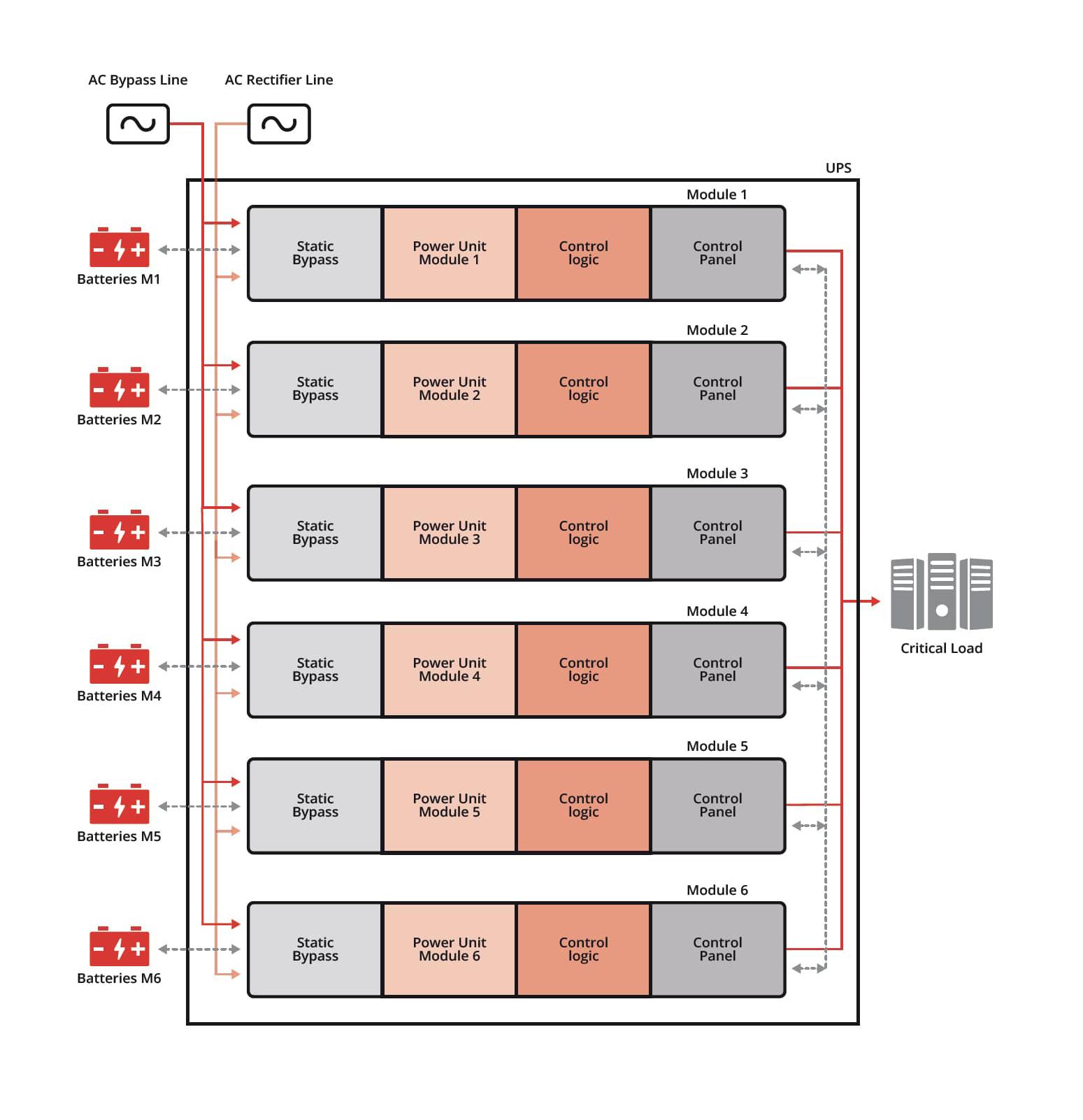
Centiel architecture eliminates single points of failure at the topology level — so when a component fails, the load stays online and the fault stays contained.

SPOF elimination
No shared failure paths. No central control logic. DDM technology means decisions are distributed across modules — the system responds to the sum of individual module decisions rather than a single point of control.

Concurrent maintainability
Hot-swap modules, isolated fault domains, and service access designed for 24/7 operation. Maintenance without exposure, without windows, without SLA risk.

Modular scalability
Capacity grows in increments — not overhauls. Add power without redesign, without load interruption, without stranded investment.

Tier III/IV alignment
Architecture designed to support Uptime Institute Tier III/IV requirements. Documentation that facilitates your certification pathway.

Designed for modular ePod environments, not single-site improvisation
Footprint Is an Availability Decision
In colocation projects delivered through ePods, availability is shaped upstream, in how UPS infrastructure occupies space and integrates with prefabricated designs.
Footprint is treated here as an architectural variable, not a packaging constraint, because it directly affects cooling margins, service access, and how reliably capacity can scale.
Our modular UPS architectures deliver up to 1 MW per square meter, freeing usable space for cooling while maintaining high efficiency and controlled heat dissipation.
This allows higher density without compressing maintenance margins, and supports phased expansion without redesign or disruption in live environments.

Freedom to choose today’s battery chemistry without locking in tomorrow’s decisions
Designed for Multiple Battery Technologies
The architecture is battery-agnostic, adaptable to different lithium technologies and future chemistries, and designed to integrate cleanly with bus-bar-based layouts.
AC connections are engineered through configurable flanges, top or bottom, matched to the project’s bus-bar design, enabling precise dimensioning without forcing standard layouts into non-standard builds.
Handled this way, footprint stops being a constraint to negotiate and becomes a mechanism for predictable integration, disciplined growth, and sustained availability at scale.
Design choices compound. So do the outcomes.
Architecture translates into operations. These are the measurable results of how Centiel systems are designed — from redundancy topology to maintenance access to expansion path.

Maintenance without negative impact
Hot-swap modules and isolated fault domains. No maintenance windows, no customer notifications, no SLA exposure during service.

SLA confidence
Distributed redundancy with no shared failure paths. Uptime targets become defensible commitments, not hopeful claims.

Growth without redesign
Modular capacity increments. Expand when demand requires — no stranded capex, no architectural rework, no load interruption.

Tier pathway support
Architecture and documentation aligned with Uptime Institute Tier III/IV power-path expectations. Audit-ready evidence for the UPS side of certification.
Start from what you need to solve.
Different roles, different pressures, different entry points.
Select your priority — we’ll show you how the architecture addresses it, with proof.

Minimize downtime risk
(Facilities & Critical Infrastructure Leaders)
Understand how failure paths are eliminated and what MTTR/MTBF evidence looks like in practice.

Reduce deployment lead time
(Operations & Engineering)
See how 4–6 week delivery* works — process, capacity reservation, and what protects your commissioning window.

Support Tier certification pathway
(Design Authorities & Consultants)
Architecture and documentation aligned with Uptime Institute Tier III/IV power-path expectations. What we contribute, scoped clearly.

Optimize total cost of ownership
(Finance & Procurement)
Model 15-year lifecycle economics: acquisition, energy, maintenance, and downtime risk in a format finance accepts.

Scale without redesign
(Facilities & Critical Infrastructure Leaders)
Modular expansion that grows with demand — no stranded capex, no architectural rework, no load interruption.
Two layers of proof: how the system is designed, and how it performs in the field.
Design decisions require evidence. Here’s ours.
Architecture and operation. Both documented.
Architecture, standards, and topology — the engineering foundation that eliminates failure paths before operation begins.
Designed Not to Fail
Architecture, standards, and topology — the engineering foundation that eliminates failure paths before operation begins.

DARA distributed architecture
Designed for up to 99.9999999% availability. Redundancy at the topology level. No shared failure paths, no single points of failure in the power chain.

Standards alignment
IEC 62040 compliance. Architecture aligned with IEEE, NFPA, and Uptime Institute Tier III/IV power-path expectations.

Concurrent maintainability
Hot-swap capability and isolated fault domains. Designed for service access without load interruption.

Modular scalability
Capacity expansion in increments. Architecture supports growth without redesign or stranded investment.

Why Centiel Exists
Centiel was created to solve a structural problem in mission-critical power: systems that only reveal their weaknesses once they are live. This is the engineering intent behind every architecture decision that follows.

Proven in operation
Field performance, deployment record, and third-party recognition.
Not marketing — measurable outcomes.

Redcentric, Heathrow, London
Live legacy UPS replacement with zero downtime. Efficiency from below 90% to above 97%. Scalable architecture ready for AI workloads.

Taipower, Taiwan
Government procurement selection. Tight schedule delivered. Modular architecture supporting national AI and cloud infrastructure.

32 years in mission-critical power
Engineering continuity. Not a startup, not a rebrand — three decades of UPS architecture development.

Typical 4–6 week lead time
Subject to configuration, order confirmation, and prevailing supply conditions.


Talk With Us @ DCW 2026 London - March 4-5
Register here

Start with what moves your decision forward.
Different stages, different needs. Select the resource that fits where you are right now.
Validate lead time
Typical 4–6 week delivery*. How it works, what’s required, what protects your schedule.
Build the cost case
15-year TCO model. Capex, energy, maintenance, downtime risk — in a format finance accepts.
Support Tier certification
Architecture and documentation aligned with Uptime Institute Tier III/IV power-path expectations.
See deployments
Colocation case studies with capacity, configuration, timeline, and outcomes documented.
Disclaimer: Performance figures are based on architectural modelling and configuration-specific assumptions. Actual performance depends on system configuration, installation environment, maintenance practices, and operating conditions. Tier certification is granted by independent third-party assessment bodies and depends on full compliance with facility design. Typical lead time 4–6 weeks, subject to configuration, order confirmation, and prevailing supply conditions.