
Riding through a grid fault is half of what data centre grid codes ask; the more useful number is how fast demand returns once the fault clears.
Key Takeaways
- Fault ride-through for data centres has moved from proposal to rule. ERCOT’s ride-through requirements for large computational loads took effect on 1 August 2026. Fingrid has applied its large-demand requirements to facilities connected directly to its transmission grid since 12 June 2026.
- Grid codes judge two behaviours: staying connected through the voltage dip, and restoring demand quickly once it clears. The second is where conventional UPS restart logic, designed to be gentle on generators, takes its time.
- Centiel StratusPower™ ePlex covers the full ride-through range today, with battery support down to 0 pu, and simulation models are available on request.
The full guide compares the requirements side by side and gives you eight points to write into your next tender.
Get the guide (PDF)
The grid now counts on the data centre to stay connected
System operators now treat large data centres as part of the grid’s response to a fault. Campuses have grown large enough, and electronic enough, to move system frequency on their own. A short transmission fault, typically 100 to 250 ms, is a routine event. When the facility stays connected and brings its demand back as soon as the voltage recovers, generation and demand stay balanced and the fault stays local.
The first rules are now in force. In Texas, ERCOT’s NOGRR 282 sets frequency and voltage ride-through requirements for large computational loads; the PUCT approved it on 9 July 2026 and it took effect on 1 August 2026. In Finland, Fingrid’s draft KJV2026 code sets fault ride-through and power-limiting requirements for demand facilities above 30 MW, with entry into force targeted for March 2027. Requirements consistent with it already apply to large facilities connected directly to Fingrid’s transmission grid. Denmark (Energinet, 2022, revised 2024) and France (RTE, 2024) published their own requirements earlier.
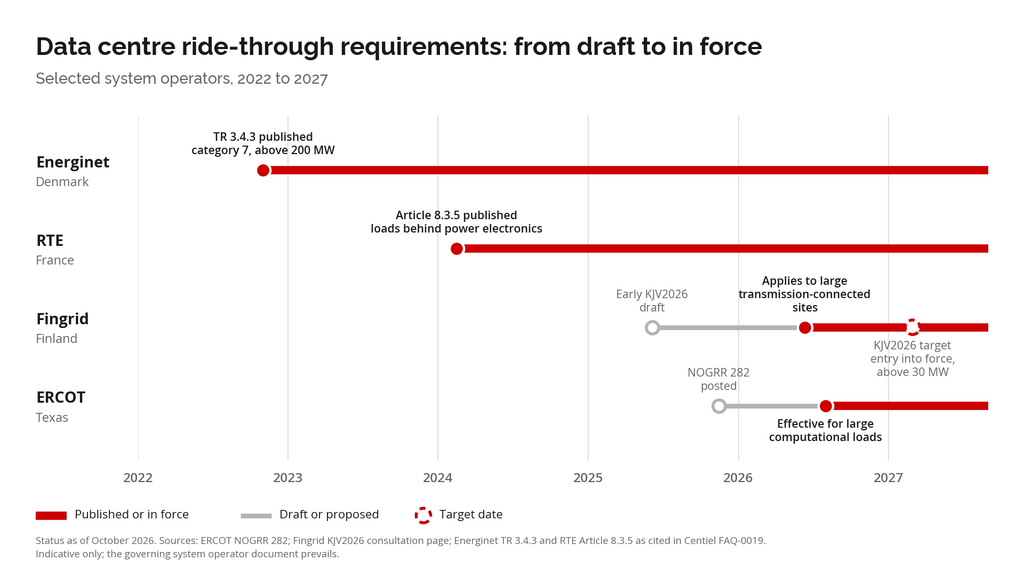
Data centre ride-through requirements by system operator, 2022 to 2027. Status as of October 2026.
The requirement is measured at the point of connection, for the whole facility, and most of the load behind that point sits behind a UPS.
Ride-through and recovery are engineered separately
A UPS can carry the load perfectly through a voltage dip and still miss the grid code, because of what it does afterwards. Most of the time is lost on the way out of the fault, and grid codes now set a deadline for getting demand back. Conventional restart logic, built to be gentle on generators, was never designed to meet one.
Economy modes come with a catch on sites subject to fault ride-through. The guide explains what it means for your energy model.
How StratusPower™ ePlex rides through and recovers
StratusPower™ ePlex uses a dedicated battery converter so the grid and the battery can share the load during a disturbance, under full control. The inverter keeps supplying the critical load throughout. The full capability table, from deep-dip ride-through to repeat events, is in the guide.
StratusPower™ ePlex is available now, Swiss made, with PSCAD and PSS/E models on request.
Next Steps: download the Fault Ride-Through for Data Centres guide
Fault ride-through is simplest to meet when it enters the specification before the connection application. Fault Ride-Through for Data Centres, written by Gerardo Lecuona, Co-founder and CEO, gives consulting engineers, data centre designers and operators what that specification needs:
- Eight points to write into a tender, so every manufacturer answers on the same terms
- The requirements of system operators in Europe, the US and Australia, side by side
- How recovery is engineered separately from ride-through, and the deadline each code sets
- The requirements that are easy to overlook: RoCoF, phase jump, repeat events and voltage imbalance
- The economy-mode catch and what it means for the energy model
- The StratusPower™ ePlex capability table
Bring a specification to the connection application that already answers the system operator’s questions.
FAQ
What is fault ride-through for data centres?
Fault ride-through (FRT) is the requirement for a data centre to stay connected to the grid and keep drawing power during a short voltage disturbance, then restore its demand quickly once the disturbance clears. Because most data centre load sits behind a UPS, the UPS largely determines whether the facility complies.
Which grid codes require fault ride-through for data centres?
ERCOT has required it in Texas for large computational loads since 1 August 2026. Fingrid applies it to large facilities connected to its transmission grid, and its KJV2026 code is targeted for March 2027. Energinet in Denmark and RTE in France published requirements earlier, and Ireland has approved its own rule. The guide compares them side by side.
Does fault ride-through apply to my project?
It depends on the system operator, the facility size and where the site connects. Full ride-through applies to data centres from 30 MW in Finland and 75 MW in Texas, and Ireland covers every transmission-connected facility. Where a site is transmission-connected or likely to expand, designing for the requirement now keeps the power path from being reworked later.
Can Centiel support a connection permit application?
Yes. Send your Centiel representative the project name, the system operator and the point-of-connection voltage. Centiel provides a compliance statement against the applicable requirement, together with PSCAD and PSS/E models for StratusPower™ ePlex.
Additional Resources
- Fault Ride-Through for Data Centres (FAQ-0019): the full guide
- Centiel StratusPower™: product page
- ERCOT, NOGRR 282: Large Computational Load Ride-Through Requirements: primary source, approved 9 July 2026
- Fingrid, KJV2026 Grid Code Specifications for Demand Connections: primary source, consultation draft and supporting documents