Modular UPS For AI Data CentersRedundancy Architecture

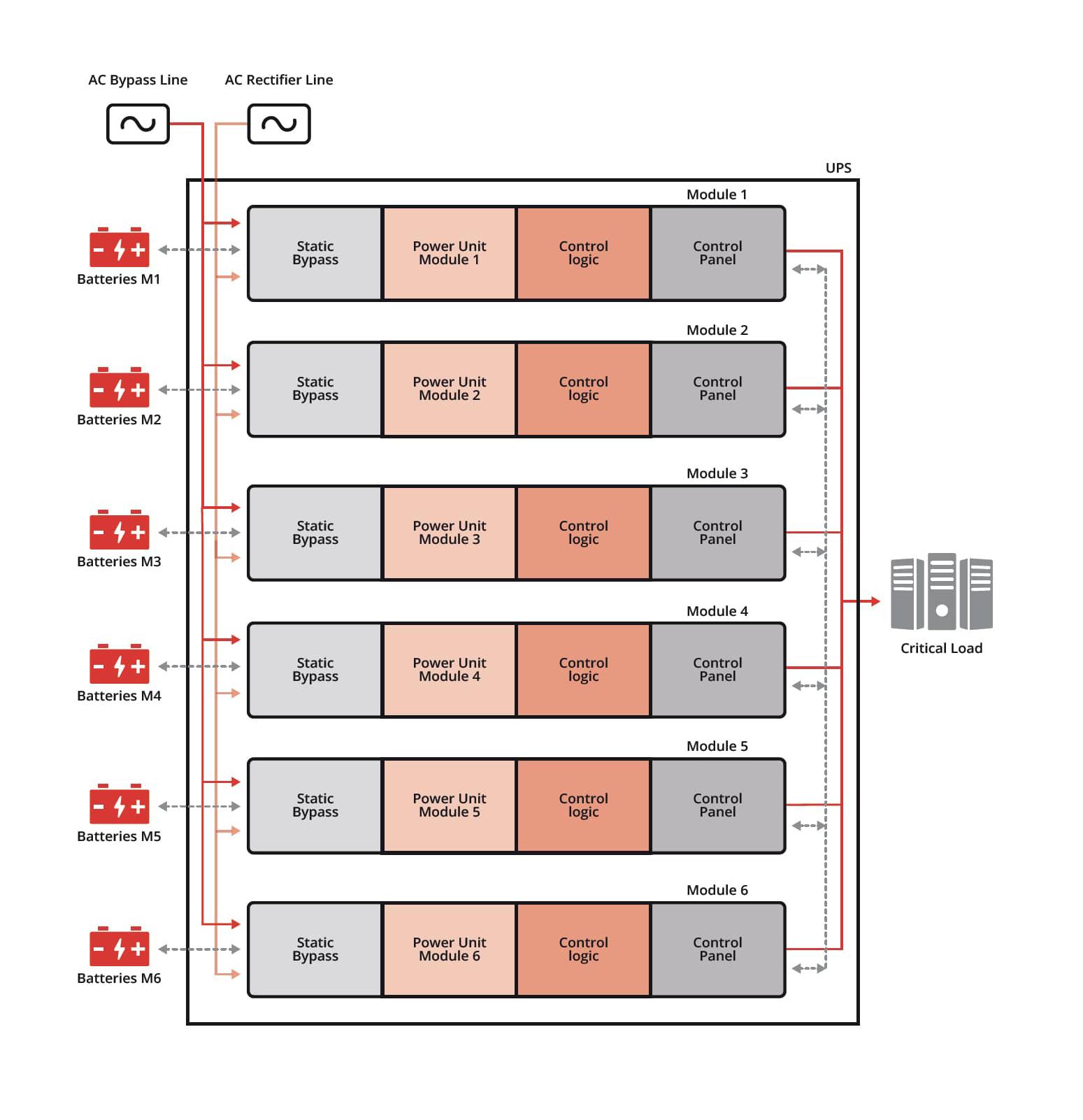
N+1 with shared control isn't N+1

A single control board. A single static bypass. A shared parallel bus. Each one a point where everything depends on one component.
Module count doesn't change that. Topology does.

Modular UPS For AI Data CentersLoad Behavior

The UPS spec passed.
The AI load didn't care.

When a training job starts, every GPU ramps simultaneously. The load concentrates — it doesn't diversify.
The real test isn't commissioning. It's the first production run.

Modular UPS For AI Data CentersLifecycle Economics

The cheapest UPS decision
is rarely the cheapest UPS.

30+ year design life. Components that don't need replacing for 15+ years.
The acquisition price is one line in a model that runs three decades.

Modular UPS For AI Data CentersIntegration & Deployment

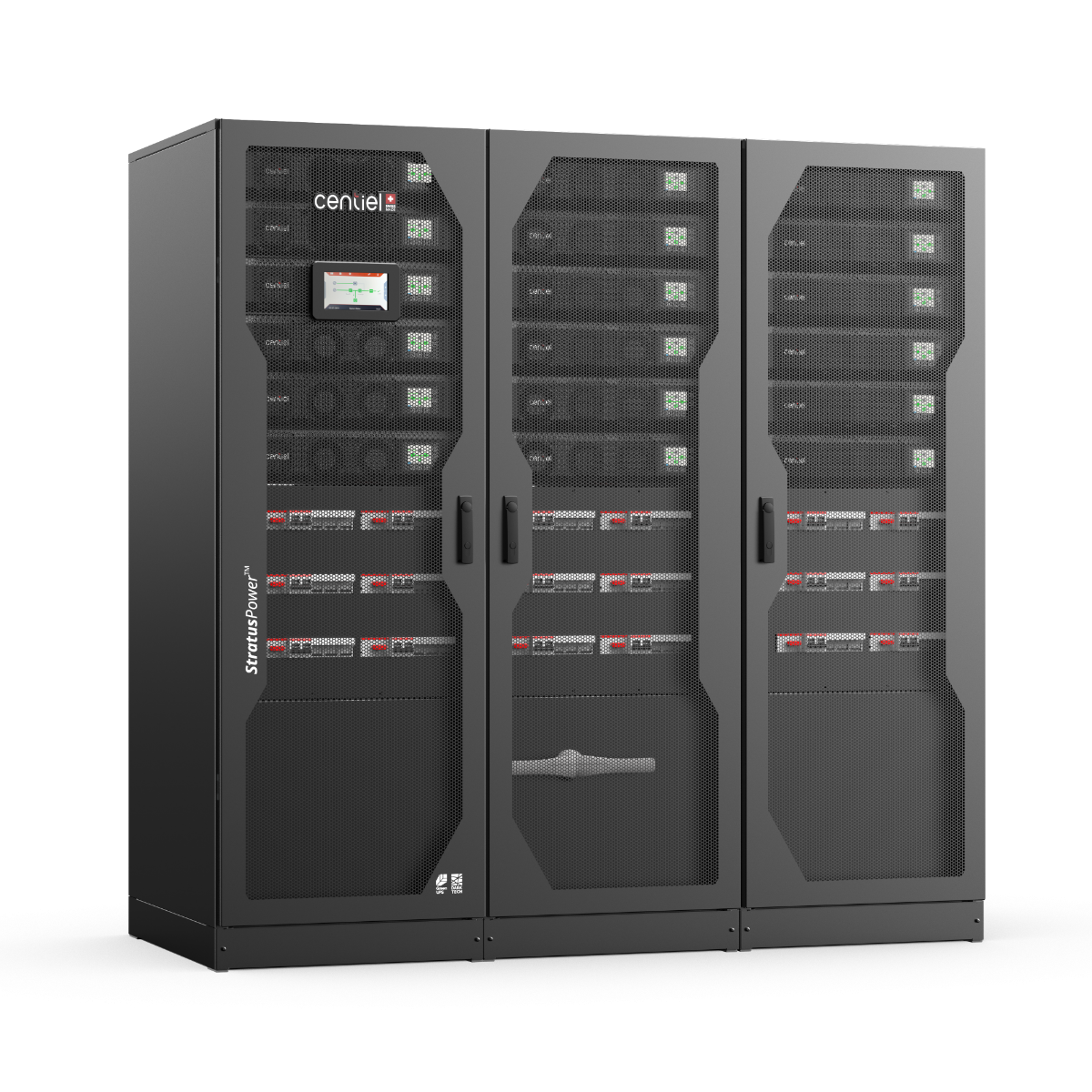
The cabinet was designed for how AI facilities are built.

Bottom or top entry. Any busbar. Any chemistry. Airflow in either direction.
When the cabinet adapts to the installation, one engineering problem disappears from the list.

9 nines

Designed UPS Availability

97.6%

True online VFI efficiency.

30+ years

UPS design life

15+ years

Component replacement life

4-6 weeks*

Typical order to
delivery lead time

32 years

Mission-critical engineering

Downtime is no longer a pause. It is an erasure.

In AI infrastructure, a power failure doesn’t pause the workload. It erases it. The cluster restarts from zero. The financial consequence arrives before the root cause is clear. And the infrastructure leader who approved the architecture is the first person in the room.

At $1M+ per significant outage, the financial consequence arrives before the root cause is identified.

The person who owns the architecture decision owns the outcome. That accountability is the reason this decision deserves the right evidence behind it

The question isn’t whether a power event is possible. It’s whether the architecture was designed so that when the grid fails, the load doesn’t even know.

Primary deployment model for AI data centers

ePOD is not a packaging option. It's how AI power infrastructure is built.

Prefabricated power pods have become the dominant deployment model for high-density GPU infrastructure — compressing timelines, enabling repeatable design, and scaling in discrete increments alongside AI compute expansion.

Centiel works directly with POD manufacturers. The UPS adapts to the environment — not the other way around. AC IN/OUT via flange or cable, matched to the POD configuration. No design compromises on the pod’s thermal or structural architecture.

Typical delivery: 4–6 weeks.* The UPS is not the variable that slips.

1 MW per square metre

In AI data centers, the UPS footprint is a thermal budget decision.

At 40–100+ kW per rack, every square metre carries a thermal consequence. Space consumed by the UPS is space unavailable for CDUs, liquid cooling distribution, and thermal buffer capacity — a direct constraint on how many GPU racks the facility can operate.

Centiel’s modular UPS delivers up to 1 MW per square metre. The power chain protects the load. The space around it protects the temperature.

Airflow designed for the installation, not the datasheet

Airflow configuration is an engineering decision, not a default setting.

GPU clusters run at sustained high load. The UPS thermal profile — how the cabinet dissipates heat and in which direction — must be compatible with the facility’s cooling architecture, not imposed on it.

Centiel cabinets support front-to-top and front-to-back airflow. Configured at project stage to match the hot aisle / cold aisle layout. An airflow path that matches the pod’s thermal architecture disappears from the problem list entirely.

Bottom or top — single smooth bend, not a forced double

How the cable enters the cabinet is a thermal and mechanical engineering decision.

Large cross-section cables — 300mm² and above — create mechanical stress and thermal consequences depending on how they enter the cabinet. A forced double bend in a confined, enclosed space limits heat dissipation and accelerates cable degradation.

Centiel’s cabinet is natively designed for bottom entry — a single smooth bend, the path the cable geometry naturally wants to take. No confined routing. No thermal derating.

Top entry is equally supported. The choice is driven by the facility design, not the cabinet.

Flanges, busbars, cables — configured to the project

The connection method adapts to the facility. The facility does not adapt to the cabinet.

Centiel supports full flange connection across all busbars — multiple flange types available to match the project’s busbar specification precisely. Or fully cabled. The connection method is a project decision, not a product constraint. For POD deployments, AC IN/OUT via whichever method the POD manufacturer requires.

The result is a clean installation that matches the design intent — not a workaround the site team has to justify for the life of the system.

Chemistry today. Chemistry tomorrow. Frame for 30 years.

The battery decision should not be locked in at UPS procurement.

Battery technology for AI data centers is not settled. Chemistry economics, fire safety regulations, and performance requirements are all evolving — what is right today may not be right at the first replacement cycle.

Centiel’s architecture is battery-agnostic: Lead Acid, Zinc, Lithium, and any future chemistry. The battery decision is not locked in at the beginning of a 30-year frame life.

That cycle should be driven by technology and economics — not by the UPS vendor’s design constraints.

Delivery as a critical path decision

When the GPU allocation has a commissioning date, the UPS cannot be the variable that slips.

In AI data center builds, time-to-revenue is a board-level metric. GPU clusters are ordered, financed, and expected to generate returns on a fixed schedule. Infrastructure that can’t match it converts capital investment into a waiting problem.

When UPS delivery is measured in months, commissioning contingency disappears. Critical path dependencies cascade. The facility isn’t ready when the hardware arrives.

Typical Centiel lead time: 4–6 weeks.* Production slot reserved at order confirmation. In ePOD environments where power integration, commissioning, and GPU installation are tightly sequenced, this is not a procurement preference. It is a schedule decision.

⚠️ Disclaimer: Subject to configuration, order confirmation, and prevailing supply conditions.

Two layers of proof: how the system is designed, and how it performs in the field.

The difference between a specification and a proof is a deployment.

Architecture and operation. Both documented.

Disclaimer: Performance figures are based on architectural modelling and configuration-specific assumptions. Actual performance depends on system configuration, installation environment, maintenance practices, and operating conditions. Tier certification is granted by independent third-party assessment bodies and depends on full compliance with facility design. Typical lead time 4–6 weeks, subject to configuration, order confirmation, and prevailing supply conditions.

Download: AI Data Center Power Resilience Guide